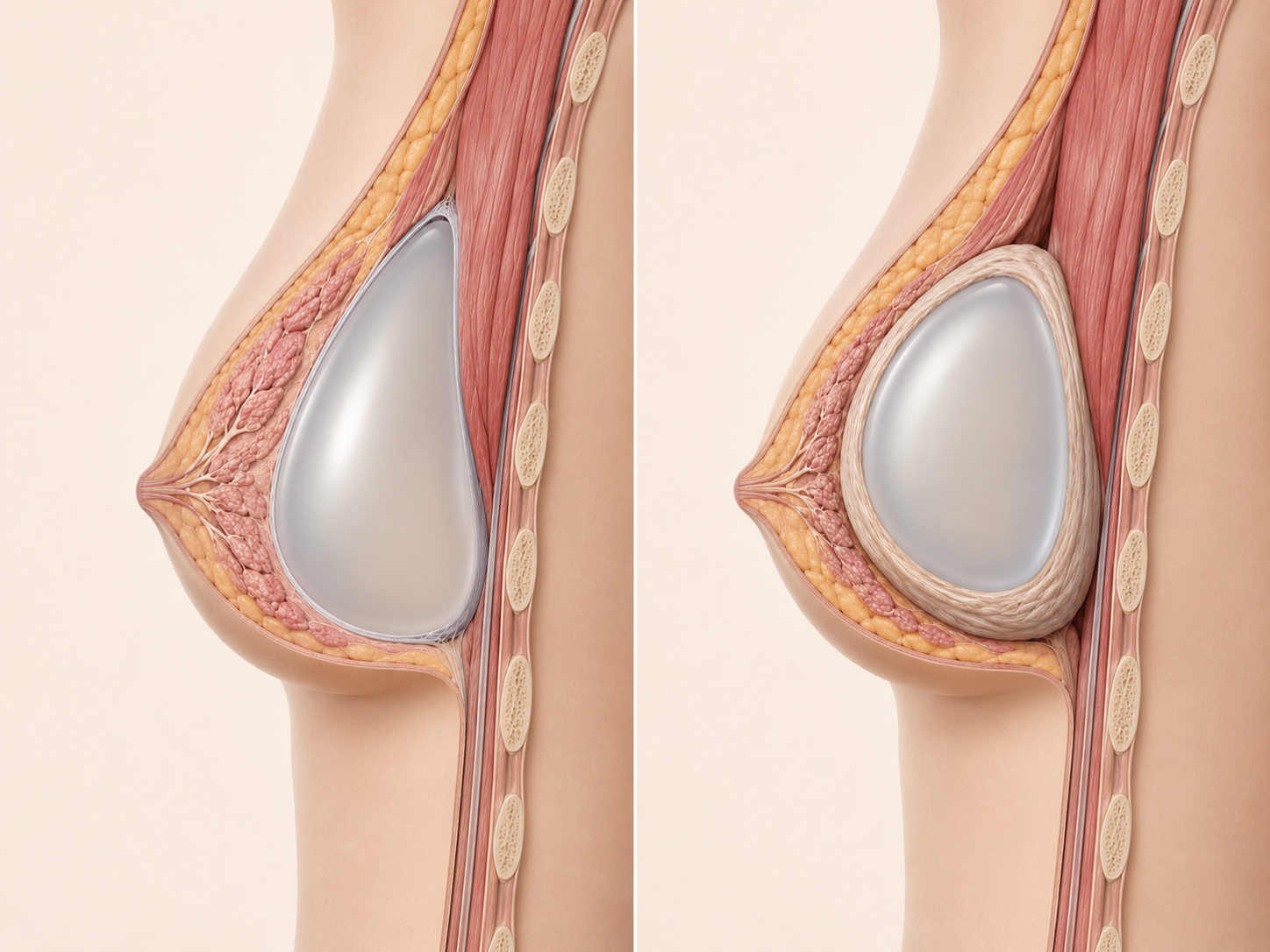
Capsular contracture occurs when the normal scar tissue around a breast implant thickens and tightens enough to make the breast feel firm, look distorted, or become painful. Mild firmness may only need observation; more advanced or bothersome contracture often requires an individualized breast revision plan.
Capsular contracture: the short answer
A capsule around a breast implant is normal. Capsular contracture is the abnormal thickening and tightening of that capsule.
Baker grades I and II are soft-to-mildly firm and may not require surgery. Grades III and IV involve visible distortion and, in grade IV, pain; revision is more commonly considered.
Sudden late swelling, a new fluid collection, a mass, or enlarged lymph nodes should not be assumed to be ordinary contracture and deserves prompt evaluation.
I see patients from Frisco, Plano, McKinney, Prosper, Allen, North Dallas, and throughout Dallas–Fort Worth who are worried because one breast has become firmer, higher, rounder, or painful after augmentation or breast reconstruction. The most useful first step is not guessing the grade online—it is determining what changed, how quickly it changed, what implant is present, and whether contracture is the only issue.
What is capsular contracture?
Whenever a breast implant is placed, the body forms a thin layer of scar tissue around it. This capsule is completely normal and should remain soft and flexible. Capsular contracture develops when the capsule becomes abnormally thick, tight, or both, compressing the implant and changing the breast’s feel or shape. The process of capsular contracture results from inflammation, collagen deposition, and contraction by scar-forming cells although no single cause explains every case.[1–3]
Capsular contracture can affect a saline or silicone implant, one breast or both breasts, and it may appear as soon as a few months or even many years after surgery. It is also possible to have a firm breast for a different reason such as implant rupture, malposition, infection, a fluid collection, or changes in the breast tissue. This is why physical examination by a board-certified physician is so important.
How common is capsular contracture?
There is no single percentage that honestly predicts every patient’s risk. Published rates vary with the indication for surgery, the generation of the implant and its surface, pocket location, the time of follow-up, history of radiation, and how contracture was defined. In two separate 10-year device studies, cumulative rates of clinically significant Baker grade III or IV contracture after primary breast augmentation were approximately 10.8% and 18.9%, respectively.[7,8] Those studies used different implants and study designs, so the numbers should be viewed as ranges from specific cohorts and not as a personal forecast.
A 2025 systematic review and meta-analysis found that subpectoral placement was associated with lower odds of contracture than prepectoral (above the muscle) placement. Additionally, it did not find a statistically significant difference in the pooled data between silicone versus saline implants.[1] The authors also emphasized substantial heterogeneity and a lack of high-quality randomized trials. That limitation is important: risk-reduction strategies can lower probability, but none can guarantee that contracture will never occur.
What does capsular contracture look and feel like?
Capsular contracture may cause changes that are subtle at first. Patients commonly describe one or more of the following:
- A breast that feels noticeably firmer than it did before or firmer than the opposite side
- An implant that sits higher, looks rounder, or appears less mobile
- A breast that looks narrower, smaller, or visibly distorted
- Increasing asymmetry or a nipple that appears to point in a different direction
- Tightness, pressure, tenderness, or pain
- A breast that feels hard or difficult to compress
Normal postoperative tightness early in the healing process is not automatically capsular contracture. Factors including timing, the trend of physical symptoms felt by a patient, and physical examination help distinguish ordinary healing from a developing problem.
The Baker grades of capsular contracture
Plastic surgeons commonly use the Baker scale to classify different degrees of capsular contracture. It does this by` assessing how firm and distorted a breast appears. Although it’s useful shorthand, it is not objective like a laboratory test. In fact, research has shown that there can be significant variation in how clinicians and patients interpret the grades.[6]
| Baker Grade | Typical feel and appearance | What it often means clinically |
|---|---|---|
| I | Soft to normal, breast looks/feels as usual. | Usually does not require surgery; observation or routine follow-up. |
| II | The breast is somewhat firm but still looks normal. | Often observed if stable and not bothersome; symptoms and implant history still matter. |
| III | The breast is firm and looks abnormal or distorted. | Revision may be considered when the change is visible, progressive, or troubling to the patient. |
| IV | The breast is hard, painful, and visibly abnormal. | Usually considered clinically significant; surgical treatment is commonly discussed unless medical factors argue against it. |
The U.S. Food and Drug Administration describes grades III and IV as severe and notes that contracture can recur after corrective surgery.[13]
Why does capsular contracture develop?
Capsular contracture is best understood as a multifactorial scarring problem. The capsule’s biology, the surgical environment, the implant pocket, and events after surgery may all contribute. Factors associated with higher risk in the literature include:
- Inflammation related to bacterial contamination or biofilm. A biofilm is an organized community of bacteria attached to a surface; it may sustain low-grade inflammation without causing the classic signs of an acute infection.[2,5]
- A postoperative hematoma, seroma, or clinical infection.[2,3]
- Prior radiation therapy, which changes tissue quality and increases fibrosis risk.[2,3]
- A subglandular pocket in some patient populations; pooled research has generally found lower contracture risk with subpectoral placement.[1]
- A previous capsular contracture or revision operation, which can make recurrence more likely.[3,4]
- Implant age, rupture, malposition, tissue thinning, and other implant-related changes that may coexist with—rather than independently cause—contracture.
Some historical studies found lower contracture rates with textured implant surfaces. However, textured implants have an established association with breast implant-associated anaplastic large cell lymphoma (BIA-ALCL). In my practice, I do not use a textured implant simply to pursue a possible contracture advantage. Implant choice must account for the complete safety profile, not one outcome in isolation.[1,12]
How is capsular contracture diagnosed?
Diagnosis usually starts with a focused history and examination. I want to know when the change began, whether it was gradual or sudden, whether pain or swelling is present, the date and type of the original implants, the pocket location, prior operations, and any history of infection, fluid, trauma, radiation, or rupture.
During the examination, I compare firmness, implant position, breast shape, skin and soft-tissue coverage, nipple position, and tenderness on both sides. Imaging is not automatically required for every mildly firm implant, but it may be appropriate when the implant history is uncertain or when rupture, a mass, fluid, or another diagnosis is possible. Ultrasound is commonly the first study for a delayed swollen breast; MRI or additional imaging may be used when the initial evaluation is inconclusive or implant integrity remains in question.[12]
When firmness or swelling should be evaluated promptly
Do not assume every late breast change is ordinary contracture
Contact a qualified clinician promptly for sudden enlargement, a new fluid collection, a new breast or capsular mass, enlarged lymph nodes, redness or warmth, fever, drainage, or rapidly increasing pain.
BIA-ALCL is uncommon and is not the same condition as capsular contracture. It most often presents as a delayed seroma around an implant with a textured-surface history, although other benign and malignant causes of late swelling must also be considered.[12]
If a patient develops delayed swelling or fluid around an implant, the correct next step is a diagnostic workup—not immediate cosmetic revision or aspiration without the appropriate laboratory testing. I explain the textured-implant association and warning signs in more detail in my Breast Implant-Associated Anaplastic Large Cell Lymphoma (BIA-ALCL) patient guide.
Does every capsular contracture need surgery?
No. A stable Baker grade I capsule is normal. A grade II breast that is only mildly firm, looks normal, and does not bother the patient may be monitored. The decision becomes more surgical when firmness is progressive, the breast is visibly distorted, pain is present, the implant is displaced, or another implant problem needs correction.
This is also a preference-sensitive decision. One patient may be comfortable observing mild asymmetry; another may find the same change unacceptable. My role is to explain what I see, what is likely to happen without treatment, what each operation can and cannot accomplish, and when doing nothing is a reasonable option.
Can medication or massage treat capsular contracture?
Massage
Massage or implant-displacement exercises are sometimes recommended after primary augmentation, but the literature has not established a reliable preventive or curative effect.[11] Once a mature capsule is genuinely contracted, aggressive squeezing does not remove the scar. Closed capsulotomy—the forceful external attempt to rupture the capsule—is contraindicated because it can damage or rupture the implant.[13]
Montelukast or zafirlukast
Leukotriene-receptor antagonists have been studied as nonsurgical treatment. A meta-analysis reported a possible benefit, particularly for montelukast in ongoing contracture, but the underlying studies were limited and the medication is used off label for this purpose.[10] It is not a guaranteed cure, it does not correct major implant malposition or advanced distortion, and any prescription requires review of medical history, interactions, and adverse effects. I would not let a medication trial delay evaluation of sudden swelling, a mass, infection, or suspected rupture.
Surgical treatment options for capsular contracture
There is no single operation called “the capsular contracture surgery.” A revision plan may combine several steps, selected after examination and sometimes imaging:
- Open capsulotomy: controlled internal releases are made in the capsule to relieve constriction.
- Partial capsulectomy: the abnormal or strategically important portion of capsule is removed.
- Total capsulectomy: the entire capsule is removed, although it does not have to come out in one intact piece.
- Implant exchange: the old implant is replaced with a new implant after the pocket and device are reassessed.
- Implant removal without replacement: the implant is removed when the patient no longer wants implants or when replacement is not the best choice.
- Pocket change: the implant is moved to a different tissue plane when coverage, position, or recurrence risk may benefit.
- Soft-tissue support: acellular dermal matrix or another scaffold may be considered in selected recurrent or complex cases.
- Fat grafting or breast lift: fat can improve selected contour or coverage problems, while a breast lift may address loose skin or nipple position that contracture surgery alone will not correct.
For a thin patient with limited implant coverage, a submuscular or dual-plane pocket may improve the implant-to-chest transition and reduce visibility. That preference is still individualized: the existing muscle, prior pocket, animation, tissue quality, and the patient’s goals all matter.
Capsulotomy, capsulectomy, and “en bloc”: what is the difference?
| Approach | What it means | When it may be considered | Important tradeoff |
|---|---|---|---|
| Open capsulotomy | The capsule is surgically released from inside the pocket. | Selected contractures when a controlled release can restore space and the capsule does not require complete removal. | Less dissection, but capsule remains. Evidence has not shown a clear recurrence advantage for capsulectomy over open capsulotomy.[4] |
| Partial capsulectomy | A portion of capsule is removed. | When only a portion of the capsule is thickened, calcified, or diseased, or when removing the entire capsule would add unnecessary risk — for example, where the capsule is densely adherent to the chest wall. Often combined with implant exchange. | Balances tissue removal with dissection risk; some capsule is intentionally retained. |
| Total capsulectomy | The complete capsule is removed, not necessarily intact or in one piece. | Severe or recurrent contracture (Baker grade III–IV), heavily calcified or thickened capsules, known or suspected silicone implant rupture, or when a patient requests complete capsule removal at the time of explant or exchange. | More extensive dissection can increase bleeding and injury risk, particularly near ribs and chest-wall structures. |
| En bloc capsulectomy | The capsule and implant are removed with a margin of uninvolved tissue as an oncologic specimen. | Reserved for confirmed or suspected BIA-ALCL, where the implant and capsule must be removed together as a single intact specimen with a margin of surrounding tissue. | Not a routine treatment for ordinary capsular contracture or elective implant removal.[14] |
A complete capsulectomy is not automatically safer or better for every patient. The safest effective operation may be an open release, partial removal, total removal, or a combination with pocket change and implant exchange. A 2024 systematic review found limited high-level evidence and no clear difference in recurrence between capsulectomy and open capsulotomy; the authors supported individualized decision-making rather than a universal operation.[4]
When might acellular dermal matrix be used?
Acellular dermal matrix (ADM) is a biologic scaffold that can reinforce the pocket and alter the interface between the implant and surrounding scar. A systematic review and meta-analysis found low recurrence in published ADM series, but the evidence was level IV and randomized trials are still needed.[9] ADM adds material, expense, and its own potential complications, so I reserve it for selected cases rather than treating it as mandatory for every first-time contracture.
Should the implant be replaced, removed, or moved to a new pocket?
The answer depends on the device and the patient’s goals. If an otherwise healthy patient wants to maintain breast volume, implant exchange may be combined with some type of surgery that addresses the capsule. When a patient no longer wants implants, removing the breast implant—with or without a lift or fat grafting—may be the better path. If the existing pocket contributes to poor coverage or position, a pocket change can be part of the correction.
Implants are not lifetime devices, but they also do not require automatic replacement on a fixed calendar. Clinicians should consider the implant’s age, integrity, symptoms, and the overall breast revision plan together. For more information on this topic, read my blog on how long breast implants last.
Can capsular contracture come back after surgery?
Yes. Recurrence is one of the most important points to discuss before revision. Published recurrence rates vary widely because studies mix different implants, pockets, grades, operations, follow-up periods, and patient populations.[4] No surgeon can responsibly promise zero recurrence.
My goal is to identify modifiable contributors when possible, choose the least risky operation that adequately corrects the problem, and address associated issues—such as rupture, malposition, inadequate coverage, or loose skin—during the same plan when appropriate. A revision that only removes an implant without considering the pocket and soft tissues may not solve the whole problem.
Can capsular contracture be prevented?
Prevention is about reducing risk, not eliminating it. Evidence and surgical principles support:
- Meticulous sterile technique and minimal implant handling
- Careful hemostasis to reduce postoperative bleeding and hematoma
- Appropriate management of infection or fluid collections
- Thoughtful incision and pocket selection based on anatomy and tissue coverage
- Atraumatic dissection and an implant size that fits the planned pocket
- Avoiding tobacco and nicotine around surgery because they impair healing and increase surgical complication risk
- Long-term follow-up when a patient notices a new change rather than waiting for severe distortion or pain
Biofilm-reduction protocols, pocket irrigation, no-touch insertion, implant plane, and other technical choices continue to be studied. Reviews support a multifaceted approach, but the quality of evidence varies and no single maneuver has eliminated contracture.[1–3,5]
What is recovery like after capsular contracture surgery?
Recovery depends on what is actually done. A straightforward implant exchange with limited capsule release is usually different from a total capsulectomy, pocket change, ADM placement, fat grafting, or combined breast lift. More extensive surgery can mean more soreness, swelling, drainage, and activity restrictions.
I give each patient a plan based on the operation and the physical demands of work, caregiving, exercise, and travel. It is more useful to discuss those real obligations than to quote a single recovery number that does not fit every revision.
My approach to treating capsular contracture
Breast revision is often more complex than a first augmentation because prior scars, stretched or thinned tissues, implant position, and the capsule all interact. In consultation, I examine the patient personally, review implant records and imaging when available, and explain which findings are definitely correctable, which are less predictable, and whether observation is reasonable.
I do not believe every patient needs the most aggressive capsule operation, and I do not believe every patient needs another implant. Some benefit from implant exchange and pocket change; some from removal, lift, or fat grafting; and some from no surgery at all. The recommendation should fit the anatomy, symptoms, safety considerations, and the patient’s goals—not a sales script.
Frequently asked questions
Can capsular contracture happen years after breast augmentation?
Yes. It can develop early or many years later. A new late change deserve evaluation because contracture, rupture, fluid, malposition, infection, and other diagnoses can overlap.
Can capsular contracture affect only one breast?
Yes. One breast may become firmer, higher, or more distorted while the other remains soft. Bilateral contracture can also occur, sometimes at different severities.
Can capsular contracture go away on its own?
A mature contracted capsule usually does not simply disappear. Mild firmness can remain stable and may not require surgery, but progressive firmness, distortion, or pain should be evaluated.
Will massage break up capsular contracture?
Massage has not been proven to reverse an established contracture. Do not forcefully squeeze an implant; closed capsulotomy can rupture the device.[11,13]
Is capsular contracture the same as implant rupture?
No. Contracture is abnormal tightening of the scar capsule; rupture is a tear or failure of the implant shell. They can occur separately or together, and imaging may be needed when rupture is suspected.
Do I need an en bloc capsulectomy for capsular contracture?
Usually not. Professional consensus reserves en bloc capsulectomy for suspected or established implant-associated cancer after appropriate workup. Ordinary contracture is treated with the operation that safely addresses the capsule, implant, pocket, and tissue findings.[14]
Will I need new breast implants?
Not necessarily. Options include exchange, removal without replacement, pocket change, lift, and fat grafting. The choice depends on implant condition, tissue, desired volume, and personal preference.
Can fat transfer replace my implants?
For selected patients, fat grafting can restore modest volume or improve contour after implant removal. It is not a one-for-one replacement for every implant size, and more than one session may be needed.
Will insurance cover capsular contracture surgery?
Coverage varies by policy, symptoms, reconstruction history, and whether the operation is considered medically necessary or cosmetic. The insurer—not the surgeon—makes the final coverage decision.
Schedule a breast implant evaluation in Frisco, Texas
A useful consultation should end with clarity—not pressure
If one or both breasts have become firm, painful, or visibly distorted after breast implant surgery, an examination can clarify whether capsular contracture is present and whether observation, imaging, or revision surgery makes sense. For more information, contact our office to schedule a consultation with Dr. Tabbal.
Written and medically reviewed by Dr. Geo Tabbal, Board-Certified Plastic Surgeon.
Last updated on August 30th, 2026.
Peer-reviewed references
1. Haas E, Christodoulou N, Secanho M, et al. Capsular Contracture After Breast Augmentation: A Systematic Review and Meta-Analysis. Aesthetic Surgery Journal Open Forum. 2025;7:ojaf003. doi:10.1093/asjof/ojaf003. DOI / source
2. Safran T, Nepon H, Chu CK, et al. Current Concepts in Capsular Contracture: Pathophysiology, Prevention, and Management. Seminars in Plastic Surgery. 2021;35(3):189–197. doi:10.1055/s-0041-1731793. DOI / source
3. Luvsannyam E, Patel D, Hassan Z, et al. Overview of Risk Factors and Prevention of Capsular Contracture Following Implant-Based Breast Reconstruction and Cosmetic Surgery: A Systematic Review. Cureus. 2020;12(9):e10341. doi:10.7759/cureus.10341. DOI / source
4. Boyd CJ, Chiodo MV, Lisiecki JL, Wagner RD, Rohrich RJ. Systematic Review of Capsular Contracture Management following Breast Augmentation: An Update. Plastic and Reconstructive Surgery. 2024;153(2):303e–321e. doi:10.1097/PRS.0000000000010358. DOI / source
5. Ajdic D, Zoghbi Y, Gerth DJ, Panthaki ZJ, Thaller S. The Relationship of Bacterial Biofilms and Capsular Contracture in Breast Implants. Aesthetic Surgery Journal. 2016;36(3):297–309. doi:10.1093/asj/sjv177. DOI / source
6. Mohan AS, Sullivan J, Tenenbaum MM, Broderick KB, Myckatyn TM. Toward a Consensus Approach for Assessing Capsular Contracture Severity and Progression: A Systematic Review. Plastic and Reconstructive Surgery. 2024;153(1):7–22. doi:10.1097/PRS.0000000000010573. DOI / source
7. Spear SL, Murphy DK; Allergan Silicone Breast Implant U.S. Core Clinical Study Group. Natrelle Round Silicone Breast Implants: Core Study Results at 10 Years. Plastic and Reconstructive Surgery. 2014;133(6):1354–1361. doi:10.1097/PRS.0000000000000021. DOI / source
8. Calobrace MB, Stevens WG, Capizzi PJ, Cohen R, Godinez T, Beckstrand M. Risk Factor Analysis for Capsular Contracture: A 10-Year Sientra Study Using Round, Smooth, and Textured Implants for Breast Augmentation. Plastic and Reconstructive Surgery. 2018;141(4S):20S–28S. doi:10.1097/PRS.0000000000004351. DOI / source
9. Samuels K, Millet E, Wong L. Efficacy of Acellular Dermal Matrix Type in Treatment of Capsular Contracture in Breast Augmentation: A Systematic Review and Meta-Analysis. Aesthetic Surgery Journal. 2024;44(1):26–35. doi:10.1093/asj/sjad265. DOI / source
10. Pașca A, Bonci E-A, Chiuzan C, et al. Treatment and Prevention of Periprosthetic Capsular Contracture in Breast Surgery With Prosthesis Using Leukotriene Receptor Antagonists: A Meta-Analysis. Aesthetic Surgery Journal. 2022;42(5):483–494. doi:10.1093/asj/sjab355. DOI / source
11. Sood A, Xue EY, Sangiovanni C, Therattil PJ, Lee ES. Breast Massage, Implant Displacement, and Prevention of Capsular Contracture After Breast Augmentation With Implants: A Review of the Literature. Eplasty. 2017;17:e41. DOI / source
12. Keane GC, Keane AM, Diederich R, Kennard K, Duncavage EJ, Myckatyn TM. The Evaluation of the Delayed Swollen Breast in Patients with a History of Breast Implants. Frontiers in Oncology. 2023;13:1174173. doi:10.3389/fonc.2023.1174173. DOI / source
Clinical and regulatory guidance
13. U.S. Food and Drug Administration. Risks and Complications of Breast Implants: Capsular Contracture. Updated December 15, 2023. DOI / source
14. Breast Surgery Collaborative Community. Consensus Statement on Breast Implant Capsulectomy Definitions and Management. June 12, 2024. DOI / source


