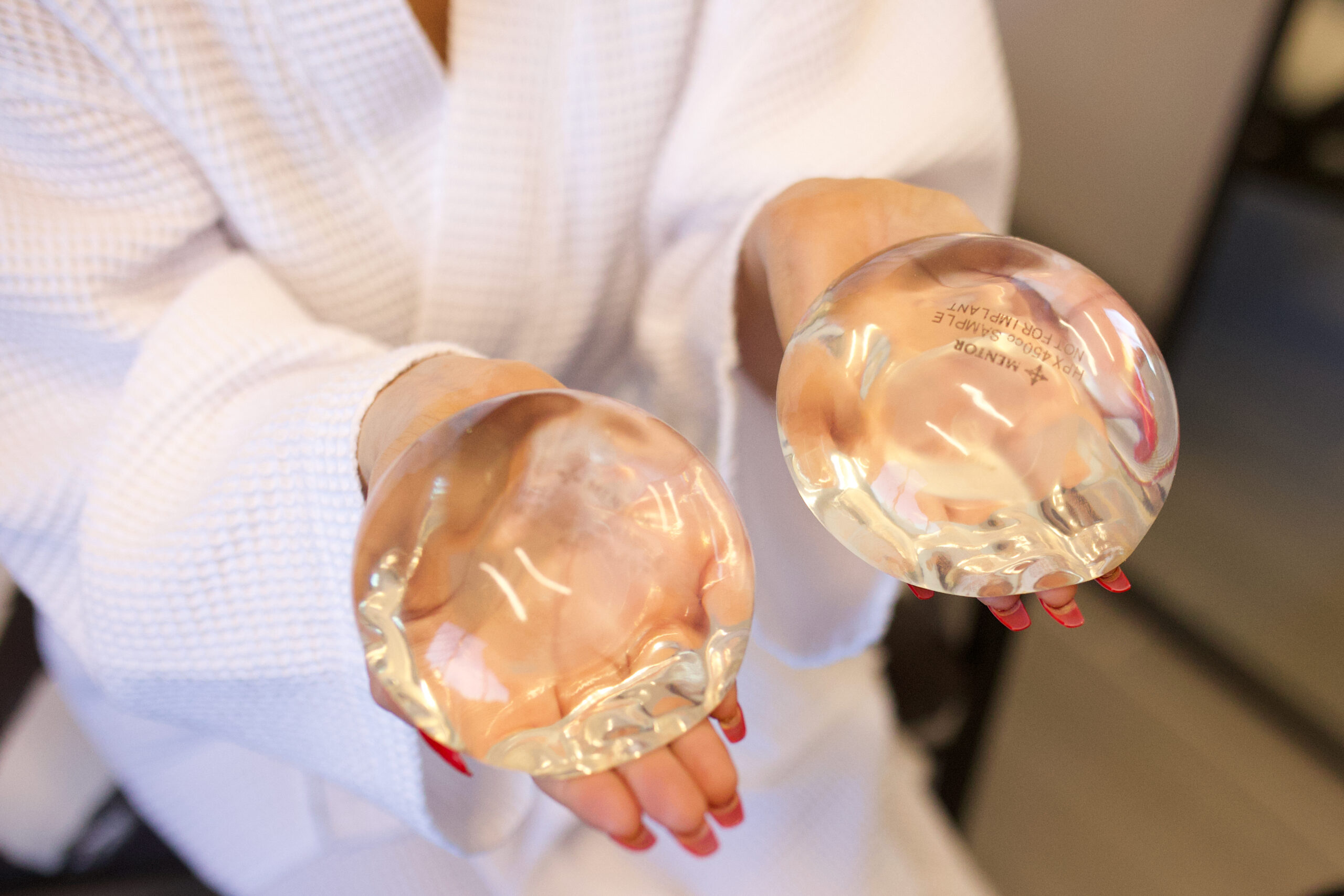
A common question I get asked during breast implant consultations at my office in Frisco, Texas, is:
“Do breast implants cause cancer?”
The short answer is no, but there is an important exception that every woman considering breast surgery with breast implants should understand.
Breast Implant-Associated Anaplastic Large Cell Lymphoma (BIA-ALCL) is a rare cancer of the immune system, not a cancer of the breast tissue itself. It develops from the capsule (or scar tissue) surrounding certain breast implants. So, while breast implants do not directly cause cancer, the scar tissue in the capsule that is formed by the body around the implant can lead to a rare cancer known as BIA-ALCL. Fortunately, this has been found almost exclusively in patients with a history of textured breast implants.
Although hearing the word “lymphoma” can be alarming, the good news is that BIA-ALCL is uncommon, highly treatable when diagnosed early, and has an excellent prognosis for most patients.
As a board-certified plastic surgeon practicing in north Dallas, I believe every patient deserves an honest discussion about both the benefits and risks of breast implants. Understanding BIA-ALCL allows patients to make informed decisions and recognize symptoms that should prompt evaluation.
What Is BIA-ALCL?
Breast Implant-Associated Anaplastic Large Cell Lymphoma (BIA-ALCL) is a rare type of T-cell non-Hodgkin lymphoma. Unlike breast cancer, it does not originate from breast tissue. Instead, it develops within the fibrous capsule that naturally forms around a breast implant. Most patients present many years after surgery, with the average diagnosis occurring approximately 8–10 years after implantation, although cases have occurred earlier and later.
Does Every Breast Implant Carry This Risk?
Current evidence demonstrates that the overwhelming majority of confirmed BIA-ALCL cases have occurred in women who have had textured breast implants.
To date:
- Smooth breast implants have not shown the same established association.
- The highest risk has been associated with macro-textured implant surfaces.
- The exact mechanism remains under investigation, but implant surface characteristics appear to play an important role.
For this reason, many plastic surgeons, including myself, have transitioned almost exclusively to using smooth implants for cosmetic breast augmentation.
Why Were Textured Implants Created in the First Place?
Textured implants were originally designed to:
- Reduce implant movement
- Lower rates of capsular contracture in selected situations
- Stabilize anatomically shaped (“teardrop”) implants
Over time, however, accumulating evidence demonstrated an association between textured implants and BIA-ALCL, fundamentally changing implant selection worldwide.
Why Does BIA-ALCL Develop?
Researchers continue to study the exact cause. Current evidence suggests the disease likely develops from multiple contributing factors, including:
- Chronic inflammation
- Implant surface texture
- Biofilm (bacterial colonization)
- Individual genetic susceptibility
- Long-term immune stimulation
No single theory completely explains why BIA-ALCL develops, and ongoing research continues to improve our understanding.
What Are the Symptoms of BIA-ALCL?
Most women with breast implants will never develop BIA-ALCL. The most recent research has shown that between 1 in 1,000 and 1 in 40,000 people with breast implants will develop BIA-ALCL, although it’s important to remember that this only applies to women who have or had textured implants. If your breast implant is smooth, you should not need to worry about this risk.
Patients should contact their plastic surgeon if they notice:
- Sudden swelling of one breast
- Breast enlargement
- Persistent breast pain
- A lump in the breast or armpit
- Firmness or asymmetry
- Skin changes over the breast
- Fluid accumulation around their implant, especially if it has been years since surgery
The most common presenting symptom is a late seroma, or fluid collection surrounding the implant years after implantation.
How Is BIA-ALCL Diagnosed?
If BIA-ALCL is suspected, evaluation generally includes:
- Physical examination
- Ultrasound
- MRI when indicated
- Aspiration of any fluid surrounding the implant
- Laboratory testing including CD30 immunohistochemistry
If a mass is present, biopsy is usually performed. Early diagnosis is one of the most important factors associated with successful treatment.
Is BIA-ALCL Curable?
Fortunately, yes. In most cases, BIA-ALCL is curable.
When diagnosed before the disease has spread, treatment will typically consist of complete removal of the breast implant and the surrounding capsule. It is worth mentioning that en bloc capsulectomy is not always required. Generally speaking, the goal is to remove the implant and complete surgical excision of the affected tissues; surgical margins aren’t necessary.
Patients with more advanced disease may require chemotherapy, immunotherapy, or additional treatments directed by a multidisciplinary oncology team.
When treated early with complete surgical excision, long-term survival is excellent.
Should Women with Textured Implants Have Them Removed?
This is another very common question patients ask me. For women without symptoms, current expert recommendations generally do not advise routine removal of textured implants solely to prevent BIA-ALCL because there is no definitive evidence that prophylactic implant exchange eliminates future risk. Management should be individualized after discussing the risks and benefits with a board-certified plastic surgeon.
There are reasons why some women will still elect to undergo implant exchange and they include:
- Anxiety about future risk
- Implant age
- Desire for cosmetic revision
- Capsular contracture
- Implant rupture
- Personal preference
At the end of the day, every patient’s situation is unique. This underscores why honest, direct communication between a patient and their board-certified plastic surgeon is so important.
My Approach to Breast Implant Safety
Patient safety is, and always will remain, my number one priority. It influences every recommendation I make. As a result, for cosmetic breast augmentation surgery, I exclusively use smooth silicone gel implants. These have not demonstrated the established association with BIA-ALCL seen with textured implants. While there will always be risks associated with breast augmentation surgery, there has never been a good reason to place my patients at a higher risk for something that can be avoided altogether.
Frequently Asked Questions About BIA-ALCL
Is BIA-ALCL breast cancer?
No. It is a rare lymphoma involving immune cells that typically develops in the capsule or scar surrounding a breast implant.
Can mammograms detect BIA-ALCL?
Not usually. Diagnosis typically relies on imaging of peri-implant fluid or masses, aspiration of fluid, and specialized pathology testing.
Should I replace my implants because of BIA-ALCL?
Not necessarily. Decisions should be individualized after discussing your implant type, symptoms, personal risk factors, and treatment goals with your plastic surgeon.
Should I worry if I’ve had implants for many years?
Most women with breast implants never develop BIA-ALCL. However, any new swelling, fluid collection, or breast enlargement years after surgery should be evaluated promptly.
Final Thoughts
Although BIA-ALCL has received significant media attention, it is important to keep the risk in perspective. The condition is uncommon, is primarily associated with textured breast implants, and is highly treatable when recognized early.
The best approach is not fear; it’s education. Patients should understand the symptoms, attend routine follow-up appointments, and seek evaluation if changes develop years after breast implant surgery.
If you are considering breast augmentation or have questions about your existing breast implants, I encourage you to schedule a consultation. Together, we can review your implant history, discuss your individual risk profile, and determine the safest plan for your long-term health.
Written and medically reviewed by Dr. Geo N. Tabbal, Board-Certified Plastic Surgeon.
Last updated on August 3oth, 2026.
References
-
Nelson JA, McCarthy C, Dabic S, et al. BIA-ALCL and Textured Breast Implants: A Systematic Review of Evidence Supporting Surgical Risk Management Strategies. Plast Reconstr Surg. 2021;147(5S):7S-13S. doi:10.1097/PRS.0000000000008040.
-
Clemens MW, Myckatyn TM, Di Napoli A, et al. American Association of Plastic Surgeons Consensus on Breast Implant-Associated Anaplastic Large-Cell Lymphoma. Plast Reconstr Surg. 2024;154(3):473-483. doi:10.1097/PRS.0000000000011370.
-
Clemens MW, Jacobsen ED, Horwitz SM. 2019 NCCN Consensus Guidelines on the Diagnosis and Treatment of Breast Implant-Associated Anaplastic Large Cell Lymphoma (BIA-ALCL). Aesthet Surg J. 2019;39(Suppl_1):S3-S13. doi:10.1093/asj/sjy331.
- “Breast Implant-Associated Anaplastic Large Cell Lymphoma (BIA-ALCL).” American Society of Plastic Surgeons, www.plasticsurgery.org/patient-safety/breast-implant-safety/bia-alcl-summary. Accessed 3 Aug. 2026.


