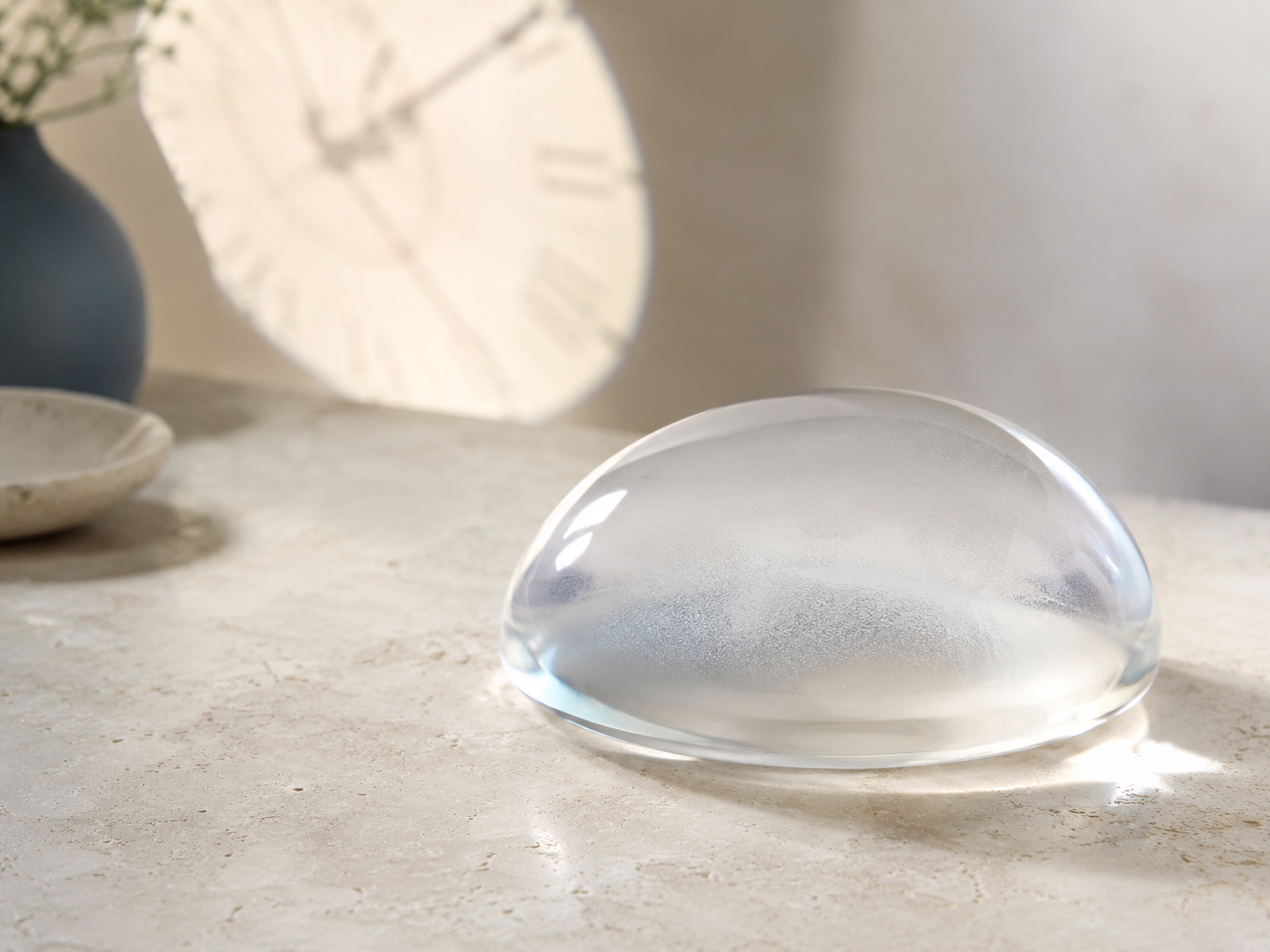
The short answer is that breast implants are not considered lifetime devices, but there is no universal expiration date and they do not automatically need to be replaced every 10 years. Some implants may require surgical revision earlier, while others will remain soft, intact, and aesthetically satisfactory for 20 or 30 years or even longer.
There is a common misconception that breast implants must be exchanged at the 10-year mark. This is simply not true. Ten years is better understood as a point when the cumulative likelihood of rupture, capsular contracture, or another reason for revision has increased and not a mandatory replacement deadline.
At my plastic surgery practice in Frisco, Texas, I evaluate each patient individually. If your implants are structurally intact, your breasts remain soft, you are happy with their appearance, and you have no concerning symptoms, implant age alone shouldn’t be a reason to undergo another surgery. However, implant surveillance with imaging, particularly for silicone implants, and ongoing follow-up with a board-certified plastic surgeon is crucial.
Breast Implants Do Not “Expire” at 10 Years
Breast implants are medical devices exposed to years of movement, pressure, tissue changes, and normal aging. Their outer shells can weaken over time, and the surrounding breast can change even when the implant itself remains intact.
Long-term clinical studies demonstrate why it is impossible to promise one precise lifespan for every implant. In a 10-year prospective core study of Natrelle round silicone implants, Spear and colleagues reported MRI-cohort rupture rates of 13.0% by patient and 7.7% by implant. A separate 10-year study of Sientra implants reported an overall rupture rate of 8.6% by patient across study cohorts. These numbers are not interchangeable: the devices, patient populations, methods of surveillance, and definitions used in each study differed. They do, however, illustrate that many implants remain intact at 10 years while the cumulative risk of a complication increases with time.[1,2]
A review of silicone implant rupture similarly concluded that rupture rates are initially low and tend to rise after approximately six to eight years. That does not mean an implant should be removed at year eight—or replaced automatically at year ten. It means implant age is one factor to consider alongside symptoms, imaging findings, physical examination, implant type, surgical history, and the patient’s goals.[3]
What Does “Breast Implant Lifespan” Actually Mean?
When patients ask how long an implant lasts, they may be asking several different questions:
- How long will the implant shell remain intact?
- How long will my breasts continue to look the way they do now?
- How likely am I to need another breast operation?
- When should I begin checking for a silent silicone implant rupture?
These are related questions, but they do not have identical answers. An implant may remain intact while a patient develops breast sagging, implant displacement, rippling, or capsular contracture. Conversely, a silicone implant can rupture without causing an obvious change in appearance.
For that reason, a reoperation rate is not the same as an implant-failure rate. Patients undergo breast revision for many reasons unrelated to rupture, including a desire to change implant size, correct asymmetry, improve breast shape, treat capsular contracture, or address changes following pregnancy, weight fluctuation, or aging.
How Long Do Silicone Breast Implants Last?
Modern silicone gel implants may remain intact for many years, and some patients never require replacement. The challenge is that a rupture can be “silent,” meaning it may not be detectable by looking at the breast or examining it by hand.
When a silicone implant ruptures, the cohesive gel often remains within the scar capsule that naturally forms around the implant. Some patients notice firmness, discomfort, a change in shape, swelling, or asymmetry, but others notice nothing at all. This is why imaging surveillance matters even when the breasts look and feel normal.
The FDA currently recommends that asymptomatic patients with silicone gel implants obtain their first ultrasound or MRI five to six years after implantation and every two to three years thereafter. MRI remains highly sensitive for silicone implant rupture, while high-resolution ultrasound can be an effective and more accessible screening option. If an ultrasound is abnormal or inconclusive, an MRI may be recommended.[4]
Routine implant-integrity imaging is separate from breast-cancer screening. Mammography should continue according to your age, personal risk factors, and the advice of the clinician managing your breast-cancer screening. Be sure to tell the imaging facility that you have breast implants so the appropriate mammographic views can be obtained.
How Long Do Saline Breast Implants Last?
Saline implants also have no fixed expiration date. Their principal advantage in rupture detection is that a leak is generally obvious. If the shell fails, the sterile saline is absorbed by the body and the breast gradually or rapidly loses volume.
A deflated saline implant is not usually a medical emergency, but it does require evaluation and typically surgery to remove and replace the failed device if the patient wants to maintain her breast volume. The breast implant shell does not dissolve and should not simply be left indefinitely without assessment.
With silicone implants, rupture may be silent. With saline implants, rupture usually reveals itself through visible deflation. This difference affects monitoring, but it does not make either implant a lifetime device.
Why Might Breast Implants Need to Be Replaced?
Breast implant revision may be appropriate for a medical reason, an aesthetic reason, or a combination of both.
Implant rupture or saline deflation
A confirmed silicone rupture or visibly deflated saline implant is a common reason to discuss implant removal or exchange. The operation may also include removal of some or all of the surrounding capsule depending on the clinical findings; capsulectomy is not automatically necessary in every implant exchange.
Capsular contracture
Every breast implant develops a layer of scar tissue around it. This is a normal healing response. In some patients, that capsule can thicken, tighten, and make the breast feel firm. This will often change its shape, move the implant to an undesirable position, and can even cause discomfort. Clinically significant capsular contracture may require revision surgery even when the implant itself is intact.
Implant malposition, rippling, or asymmetry
An implant can move too low, too far to the side, or toward the center of the chest. Rippling may become visible or palpable, particularly in thin patients with limited soft-tissue coverage. These concerns may be treated by adjusting the implant pocket, changing implant size or type, adding soft-tissue support, performing fat grafting, or combining several techniques.
Changes in the breast over time
Implants do not stop the normal aging of the skin and breast tissue. Pregnancy, breastfeeding, weight gain or loss, hormonal changes, gravity, and time can alter the appearance of augmented breasts. A patient may eventually benefit from a breast lift, with or without implant exchange, even though her original implants remain intact.
A change in aesthetic goals
Some patients decide years later that they would prefer a smaller or larger implant. Others wish to remove their implants entirely. These are personal decisions—not evidence that the original implant “failed.” Implant removal may be combined with a breast lift when needed to address stretched skin or tissue descent.
Symptoms or a new breast change
Persistent swelling, a new fluid collection, a breast mass, increasing firmness, pain, or a change in breast shape should be evaluated rather than attributed automatically to normal implant aging. Although uncommon, breast implant-associated malignancies are important considerations in the appropriate clinical setting. Breast implant-associated anaplastic large cell lymphoma (BIA-ALCL), for example, has been associated predominantly with textured implant surfaces rather than smooth implants.[5]
Should I Replace My Breast Implants at 10 Years If I Have No Problems?
No, not necessarily. There is no evidence-based rule requiring every asymptomatic patient to replace intact breast implants at 10 years.
If you feel well, like your result, have a reassuring examination, and your recommended silicone implant surveillance is up to date, continued observation is probably a reasonable option. Surgery has real costs, recovery, and risks; it should have a clear indication or a goal that matters to the patient.
On the other hand, a 10-year-old implant deserves more deliberate follow-up than a relatively new device. The chance of rupture and other implant-related complications is cumulative. Your decision should be based on the implant’s condition and history, your tissues and symptoms, imaging when appropriate, and what you want and not based on a calendar alone.
Signs That Your Breast Implants Should Be Evaluated
Schedule an evaluation if you notice:
- Sudden or progressive loss of breast volume
- New asymmetry or a change in implant position
- Increasing firmness or distortion
- Persistent pain or tenderness
- New swelling, especially if it develops years after surgery
- A breast or armpit mass
- New rippling or implant visibility
- Abnormal or uncertain implant findings on ultrasound, MRI, or mammography
These symptoms do not always indicate rupture or a serious complication, but they deserve an appropriate examination and diagnostic plan.
Does Replacing Implants Before They Rupture Make Surgery Easier?
Sometimes, but this is not a reason to subject every patient to preventive surgery on an arbitrary schedule. An extracapsular silicone rupture, severe capsular contracture, calcified capsule, or substantial implant malposition can make revision surgery more involved. Earlier evaluation after a suspicious symptom or abnormal imaging result may therefore be beneficial.
However, removing every normal, intact implant at 10 years would expose many patients to an operation they probably would not need. I prefer to balance the risks of continued observation against the risks and potential benefits of revision surgery for each individual patient.
What Happens During a Breast Implant Revision Consultation?
During a breast implant evaluation at my north Dallas office, I want to understand:
- When and why your original breast surgery was performed
- The implant manufacturer, model, surface, fill, size, and placement, if records are available
- Whether you have experienced pain, firmness, swelling, or a change in appearance
- Whether your aesthetic goals have changed
- Whether your implant-integrity and breast-cancer screening are current
- The quality of your breast skin and tissue, implant position, scar pattern, and degree of asymmetry
Depending on the findings, the appropriate plan may be continued observation, diagnostic imaging, implant exchange, implant removal, capsule surgery, pocket repair, fat grafting, a breast lift, or a combination of procedures. Revision breast surgery is not one standardized operation. The plan should address both the medical issue and the patient’s desired outcome.
My Perspective as a Board-Certified Plastic Surgeon Based in Frisco, TX
I tell my breast augmentation patients to plan for the possibility that they may need another breast operation at some point in their lifetime. That is different from telling them that their implants must be exchanged every 10 years.
The most honest answer is to replace breast implants when there is a reason and not simply because a certain anniversary has arrived. That reason might be rupture, capsular contracture, implant malposition, discomfort, a change in breast tissue, an abnormal clinical finding, or a patient’s desire for a different size or shape implant.
Patients should also know which implants they have and keep their implant information for future reference. I currently favor smooth implants and avoid textured devices because of the established association between textured implant surfaces and BIA-ALCL.
If you have older breast implants, are unsure which implants you have, or have noticed a change in your breasts, a careful evaluation can help separate a true medical concern from a normal change.
Frequently Asked Questions About Breast Implant Longevity
Do breast implants have to be replaced every 10 years?
No. Breast implants are not lifetime devices, but there is no rule that intact implants must be replaced automatically at 10 years. The decision depends on symptoms, examination, imaging, implant history, breast changes, and the patient’s goals.
Can breast implants last 20 years?
Yes, some breast implants remain intact and satisfactory for 20 years or longer. However, the risk of rupture and other implant-related complications generally increases with time, so long-term follow-up remains important.
What percentage of breast implants last 10 years?
There is no single percentage that applies to every implant. Ten-year studies of different silicone implant systems have reported varying rupture, capsular-contracture, and reoperation rates. The results depend on the specific device, patient population, surgical indication, and how complications were measured.[1–3]
How do I know whether a silicone breast implant has ruptured?
Some ruptures cause firmness, discomfort, swelling, asymmetry, or a change in shape, but many are silent. Ultrasound or MRI is therefore used to evaluate silicone implant integrity.
What happens if a saline implant ruptures?
The breast usually loses volume as the body safely absorbs the sterile saline. The implant shell remains and should be evaluated by a plastic surgeon. Replacement can usually be planned rather than treated as an emergency.
Should I have an MRI every year if I have silicone implants?
Not routinely for implant surveillance. Current FDA guidance recommends the first ultrasound or MRI five to six years after silicone implant placement and repeat imaging every two to three years thereafter for asymptomatic patients. Symptoms or an abnormal study may justify imaging sooner.[4]
Will I need a breast lift when my implants are replaced?
Not always. A lift may be helpful when the breast tissue or nipple position has descended, when the skin has stretched, or when a patient is reducing implant size. The need for a lift depends on anatomy and goals, not simply implant age.
Can I remove my implants without replacing them?
Yes. Some patients choose explantation without new implants. Depending on implant size, tissue quality, and skin laxity, a breast lift or fat grafting may be considered to improve shape after removal.
Is implant replacement the same operation as my original augmentation?
Not necessarily. A straightforward exchange may be relatively limited, while surgery for capsular contracture, rupture, malposition, thin tissue, or significant sagging may require a more complex plan.
When should I see a plastic surgeon about older implants?
You should be evaluated if you develop pain, firmness, swelling, asymmetry, loss of volume, a mass, or another new breast change; if imaging suggests rupture; if you have textured implants and questions about their risks; or if you simply want to reconsider your implant size or overall breast shape.
Schedule a Breast Implant Evaluation in Dallas-Fort Worth
If you are considering breast augmentation or have questions about aging breast implants, I invite you to schedule a consultation at my office in Frisco where I see patients from surrounding communities including Plano, McKinney, Prosper, and Allen.
During your consultation, I will examine you personally, review your implant and surgical history, discuss whether imaging is appropriate, and give you a candid recommendation. Sometimes the right answer is revision surgery. Sometimes it is continued observation. My role is to help you understand the difference without pressure.
Written and medically reviewed by Dr. Geo N. Tabbal, Board-Certified Plastic Surgeon.
Last updated on August 30th, 2026.
References
- Spear SL, Murphy DK; Natrelle Round Silicone Breast Implants Core Study Group. Natrelle round silicone breast implants: Core Study results at 10 years. Plastic and Reconstructive Surgery. 2014;133(6):1354–1361. doi: 10.1097/PRS.0000000000000021.
- Stevens WG, Calobrace MB, Harrington J, Alizadeh K, Zeidler KR, d’Incelli RC. Ten-year Core Study data for Sientra’s Food and Drug Administration-approved round and shaped breast implants with cohesive silicone gel. Plastic and Reconstructive Surgery. 2018;141(4S):7S–19S. doi: 10.1097/PRS.0000000000004350.
- Hillard C, Fowler JD, Barta R, Cunningham B. Silicone breast implant rupture: a review. Gland Surgery. 2017;6(2):163–168. doi: 10.21037/gs.2016.09.12.
- Henry N, Haddad C, Abi-Rafeh J, et al. Breast implant rupture surveillance practices among plastic surgeons in publicly funded healthcare systems. Aesthetic Plastic Surgery. 2025;49(3):741–748. doi: 10.1007/s00266-024-04345-y. This peer-reviewed article summarizes the current FDA surveillance recommendation discussed above. See also the FDA breast implant labeling guidance.
- Clemens MW, Jacobsen ED, Horwitz SM. 2019 NCCN consensus guidelines on the diagnosis and treatment of breast implant-associated anaplastic large cell lymphoma (BIA-ALCL). Aesthetic Surgery Journal. 2019;39(Suppl 1)S3–S13. doi: 10.1093/asj/sjy331.


