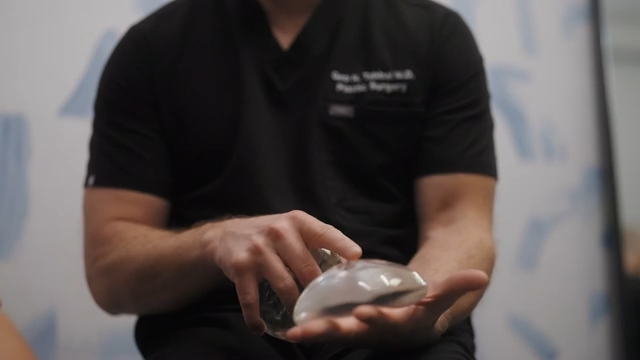
Choosing the right breast implant size and shape is one of the most important decisions you’ll make when considering breast augmentation. Many patients focus heavily on cup size or a specific cc (cubic centimeter) number, but the best outcomes come from a more thoughtful approach that considers your unique anatomy, lifestyle, and aesthetic goals. Understanding some of these key factors helps you achieve natural-looking, proportionate results that enhance your confidence for years to come.
In this article, board-certified plastic surgeon Dr. Geo N. Tabbal of Frisco, Texas explains breast implant size and shape and how he uses them in tandem with a thorough assessment of a patient’s unique anatomy and goals to craft natural results.
Understanding Breast Implants and Their Uses
Breast implants are medical devices used primarily in breast augmentation to increase volume, improve symmetry, and enhance shape. They are also commonly used in combination with other procedures such as a breast lift (mastopexy) or breast reconstruction after mastectomy. Implants come in a variety of sizes, shapes, and materials (typically silicone or saline), allowing for highly personalized outcomes.
The goal is not just to go bigger, but to create harmony with your overall body proportions. As Dr. Geo Tabbal wisely notes, patients often “get caught up in size and not shape.”
Breast Implant Sizing: Beyond Just the Numbers
Implant sizing involves much more than just picking a number. Surgeons evaluate several parameters, including your existing breast tissue, chest wall width, skin elasticity, and overall body frame. The implant must fit the natural “footprint” — the base diameter of your breast — to look natural and avoid complications like rippling or “bottoming out.”
Dr. Tabbal uses an excellent analogy: “Imagine your breast as a home, and that home has a certain square footage. You don’t go buying furniture that’s bigger than the square footage of the house. You want to buy something that fits the house, and we want that dimension to fit within the dimensions of your breast.”
During consultations, surgeons often use implant sizers, 3D imaging, or photos to help you visualize potential surgical results. The focus should be on proportion — what looks balanced on your body — rather than chasing a specific cup size, which can vary significantly between bra brands.
Choosing Breast Implant Shape: Round vs. Teardrop
Implant shape dramatically affects the final appearance. The two main options are:
- Round implants — These provide more upper pole fullness, creating a fuller, rounder look that many patients desire for enhanced cleavage and a more youthful profile.
- Teardrop (anatomical) implants — These have a sloped contour that mimics the natural breast shape, with more volume at the bottom. They are often preferred for a subtler, more natural slope.
Dr. Tabbal stresses the importance of shape over size: “What [patients] should be focusing on is the shape that they’re trying to achieve, not just the size they want.”
Combining Size and Shape: Finding the Right Balance
The best results come from thoughtfully combining size and shape. For example, a moderate-profile round implant might suit someone wanting natural fullness, while a higher-profile implant can deliver more dramatic projection for patients with a narrower chest.
Low-profile implants offer subtle enhancement with wider bases, while high-profile implants provide greater projection with a narrower base. Your surgeon will help match these options to your desired outcome, whether you want a natural look or more noticeable enhancement.
Dr. Tabbal encourages patients to visualize their goals clearly: “The best thing you can do is arrive at a mental destination of what it is you want it to look like, what it is you want to feel like, and once you can arrive at that decision, it allows yourself and your doctor to reverse engineer how to arrive there.”
Implant Placement and Fat Grafting Options
Implant placement also influences size and shape selection. Implants can be placed over the muscle (subglandular or subfascial) for more upper fullness or under the muscle (submuscular) for a more natural slope and reduced risk of visible rippling.
Fat grafting (fat transfer) is another excellent option that can be used alone or in combination with implants. Fat is harvested via liposuction from other areas of the body, purified, and injected into the breasts to add natural volume, improve cleavage, or soften the look of implants. This hybrid approach is popular for patients seeking a more natural feel and contour.
The Importance of Expert Guidance
Choosing the right breast implant size and shape is a highly personal process that requires professional expertise. While online charts and photos can provide inspiration, only a thorough evaluation of your anatomy can ensure beautiful, long-lasting results that complement your body.
It is essential to consult with a board-certified plastic surgeon like Dr. Tabbal who has extensive experience with breast procedures. At our office, we analyze your unique anatomy — including tissue thickness, chest dimensions, skin quality, and lifestyle — and create a specialized surgical plan just for you. Schedule a consultation with Dr. Tabbal today to see which breast implant size and shape would be the ideal fit for you and your goal of a natural-looking breast augmentation.
Written and medically reviewed by Dr. Geo N. Tabbal, Board-Certified Plastic Surgeon.
Last updated on August 30th, 2026.


